The River Thames Guide
Kingston Bridge to Richmond and on to Kew Bridge
— a longer walk in the Discover the Thames series
This walk starts from Kingston Bridge (Kingston is accessible by train from Waterloo) by R Turk and Sons boatyard (Turks Launches). When you arrive there you can enjoy some light refreshments nearby, and even a short boat ride perhaps. In the main this Thames Walk follows the route of the Thames Path, a long distance footpath which is signposted with the Acorn symbols, so it is easier to follow.
The full historical mapped alignment from Kingston Bridge to Kew Bridge is about 12.2 km / 7.6 miles, before station approaches, visits and diversions. You can also finish at Richmond after about 7.3 km / 4.6 miles. The remaining Richmond–Kew stretch measures about 4.8 km / 3 miles. Check the planning notes and current signs before setting out.
To start your walk you need to exit Kingston station (frequent trains from Waterloo) and walk down towards the “south” bank of the river which is clearly signposted. You will see Kingston Bridge over the river, but do not cross over the bridge – instead drop down the stone steps until you are on the promenade beside the river. At the bottom of the stone stairs turn right and follow the walkway towards R Turk and Son’s boatyard, with John Lewis on your right and the River Thames on your left. You walk under the railway bridge and then go through Canbury Gardens, past a nice pub (The Boater’s Inn) until you reach a road – cross over to the other side and walk on a raised path until you can see the Thames footpath by the riverside on your left once again. The footpath continues alongside the River Thames past some islands (called Steven’s Eyots) for quite some time, until you see Teddington Weir with a suspension footbridge over it.
Above image credited to Philip Halling
Continue along the riverside past Teddington’s three-lock complex. You should continue along the towpath past the locks and with playing fields and meadows with willow trees on your right. You will pass a stone obelisk (or column) – which marks the upstream boundary of the Port of London Authority’s tidal Thames jurisdiction. The Environment Agency is the navigation authority on the non-tidal Thames upstream of Teddington Lock. Just beyond this you will cross a lock entry to some open water where The Thames Young Mariners meet.
Ham House is a 17th-century National Trust house beside this stretch of river. The house and garden are a separate attraction with their own admission and opening arrangements; check the National Trust’s date-specific information if you want to go inside. House access may be by tour even when the garden is open.
Continue walking along the footpath, keeping the river on your left and you will see as the footpath and river curve around to the left the huge bulk of Richmond Hill in front of you. Richmond Hill is an optional uphill detour from the riverside walk. The Royal Star & Garter care-home residents moved from the historic Richmond building to Surbiton in 2013.
Above Marble Hill House from the Thames photo copyright by Alan Swain
At this point you can look across the River Thames and see on the opposite bank the pretty little Marble Hill House, a white villa built in the 1720s for Henrietta Howard, with lawns sweeping down towards the Thames. You now pass a slipway which goes down to the river on your left and River Lane which goes up to the one time village of Petersham on your right. Walk on past Petersham Meadows which are part of the River Thames flood plain, and are allowed to be flooded during times of excessive flow of water down the river. As the meadows come to an end the Path goes away from the river past some toilets. It then passes an old stone “grotto” which has 3 arches.
Above – Petersham Meadows and the River Thames – Photo by Malc McDonald and reproduced by kind permission of Mr McDonald and Geograph.
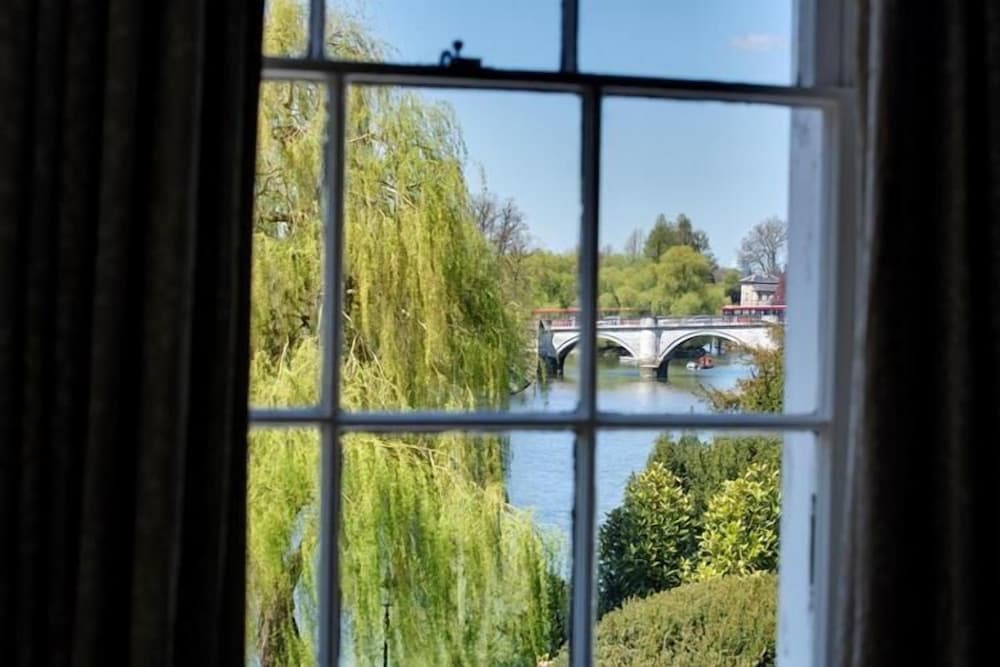
From here you can actually deviate from the Thames Path and follow the well worn trails up to the top of Richmond Hill. However, we assume that you will want to press on towards Richmond and Kew, the end of your walk along the Thames! The footpath will take you to Richmond Bridge, completed in 1777, with its five principal arches.
If you want to terminate your walk here it is a short distance to Richmond railway and Tube station – HOWEVER, we hope that you will press on to Kew!
You next walk past the grounds of the former Royal Palace of Shene, which was loved by several of our earlier Kings, including Richard II and his wife, Queen Anne of Bohemia. When she died tragically young (age 28) in 1394 from plague the King was consumed in grief, and he had the palace razed to the ground.
Your path continues by the river under a railway bridge and Twickenham Road Bridge, until you reach Richmond Lock.
Old Deer Park has historic meridian obelisks associated with the King’s Observatory, formerly known as Kew Observatory. They were used to align astronomical instruments; this guide does not assume that all the markers or the observatory are visible or accessible from the towpath.
Now you are on the last leg of your walk. You will see the beautiful grounds of Syon House and Park, laid out by the master landscape gardener of the 18th century – Lancelot “Capability” Brown. On your right are the wonderful grounds of the Royal Botanic Gardens at Kew which are world famous. Princess Augusta established Kew’s botanic garden in 1759. Its scientific collections developed through generations of plant collecting and research. Kew’s Millennium Seed Bank is at Wakehurst in Sussex, rather than on this riverside walk. A visit inside Kew Gardens requires a designated entrance and its own admission arrangements; check gate access, seasonal hours and attraction closures before combining it with the walk.
As you get ever closer to the end of your walk you will see a brick wall on your right and you can glimpse a red brick building. Kew Palace was a royal retreat for George III, Queen Charlotte and their children. Seeing the riverside setting is different from visiting the interior: the palace and other historic attractions have seasonal opening arrangements, separate from the garden’s own opening arrangements.
Passing Kew Palace you continue along the Thames Path and you will see in front of you Kew Bridge – the end of your walk.
CONGRATULATIONS! You have completed this walk. For Kew Bridge station, the archive continues across the bridge to the north side of the Thames. That crossing and station approach are outside the mapped distance. Kew Bridge station has no step-free platform access; check your return journey and access needs before setting out.
Visitor planning and selected archive facts reviewed in November 2026. The original walk was devised by Jeannette Briggs; this update is not a new on-foot survey.
Sources for selected archive updates
Walk and questions devised by Jeannette Briggs
of The River Thames Guide
© The River Thames Guide Ltd. 1999-2014