 The River Thames Guide
History of the River Thames
Follow the history of the River Thames through riverside settlements, royal palaces, trade, pollution and recovery. This illustrated account by Jeannette Briggs explores the upper river, historic towns and London.
Explore the river · Source to sea
Map of the River Thames from start to finish
Follow the Thames from its traditional source at Thames Head near Kemble, through Oxford, Reading, Windsor and London, to the Thames Estuary and the North Sea. Choose a section or select a place to explore along the river.
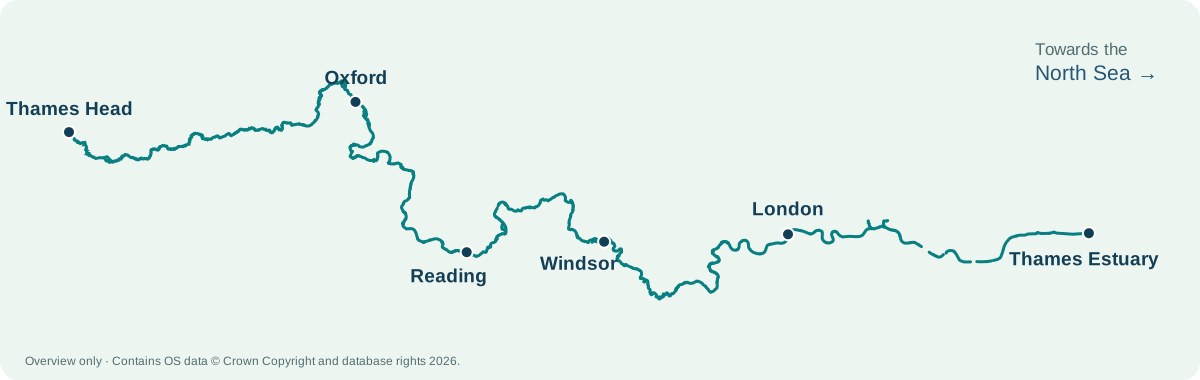
Use the river overview above and the place guides below.
The whole river at a glance
Start with the full river, then explore the upper Thames, the historic riverside towns or the tidal river through London. You can also use the town-guide links below.
River data: OS Open Rivers. Contains OS data © Crown Copyright and database rights 2026. Open Government Licence v3.0. Background map: © OpenStreetMap contributors.
This is a generalised river overview, not a walking route or navigation chart. Seasonal headwaters near Thames Head are not fully represented by the river line. The mapped channel opens into the wider estuary; there is no single point marking the transition to the sea.
Where does the River Thames start?
The traditional source is Thames Head near Kemble in Gloucestershire. The headwaters are seasonal, so you may find a dry channel rather than flowing water at the source.
Where does the River Thames end?
It flows east through London into the Thames Estuary, between Essex and Kent, and out into the North Sea. London is part of the journey, not the river’s end.
How long is the River Thames?
The river is commonly described as about 215 miles (346 km) long. This is the river’s length; it is different from the length of the Thames Path walking trail.
Read more: University of Greenwich: the River Thames and its basin · Visit Thames: finding the source.
Continue into the history of the Thames ↓Choose a chapter in the Thames story
- Early settlements and Roman London — the river as a route for people and trade.
- Royal river — palaces and life beside the Thames.
- 1858: the Great Stink — Parliament debated the polluted river and its purification. Read the contemporary debate.
- The modern river — flood protection and changing riverside communities. Explore the Environment Agency’s Thames Barrier guide.
Visit the places behind the story
Our town guides bring together local history, visiting information and relevant experiences. Check ticket and opening arrangements before making a special trip.

Researched and written by Jeannette Briggs
Upper River
From Lechlade to Eynsford the river is full of such unexpected sights and delights like kingfishers and otters, or families of ducks having their first swimming lesson across the river, or the sight of cows standing in the river with their tails gently swishing away. This lovely area of England is bounded by the Cotswolds.

The Thames at New Bridge
Photo by Jeannette Briggs
At Oxford the river seems to spring into a faster pace. Here you can take a cruise, hire a punt or motor launch or just sit at one of the many riverside pubs and watch the scullers from the world famous University Rowing Clubs in training.
Middle River
From Oxford downstream the Thames meanders its way through beautiful countryside reaches and historic settlements, with an enormous and almost inexhaustible variety of places to visit. One of them – Marlow – is a gem of Georgian architecture, for instance.

The Radcliffe Camera Oxford - built to designs by James Gibb in 1737
For the energetic walker there is the Thames Path, which stretches from the source of the river at Thames Head in the Cotswolds down to the Thames Barrier at Woolwich. Alternatively, you can have the magical experience of actually being on the river itself. You will be surprised – as I was – at how different your experience of the river will be when you on board a boat, rather than standing on the bank!

Photo by Jeannette Briggs

Photo by John Olney
Passenger boats can be found in many of the towns up and down this stretch of the river, including Oxford, Abingdon, Reading, Henley, Maidenhead, Windsor, Hampton Court and Kingston.

Maidenhead Riverside
Photo by Simon Worsfold

Photo of Hampton Court courtesy Stephen Worsfold
Lower River and London
Downstream from Teddington (a derivative of Tide-end-town!) the River Thames changes its rhythm. Though still nearly 60 miles from Southend and the North Sea the Thames becomes tidal. Twice a day the river flows back up towards its source, as the sea pushes its way up the estuary. With the falling tide the foreshore of the Thames is revealed. – a somewhat neglected part of the river, but whose mud and shingle conceal fascinating clues to the great city of London’s rich past. The Thames changes character many times as it flows through the Nation’s capital city. Suburban gardens and green open spaces of stately parks rub shoulders with Georgian mansions and new luxurious riverside homes built on former industrial sites, and huge blocks of apartments boasting riverside views. Passenger boats coming upriver from Westminster stop at Richmond, Kew, and Putney en route for Kingston and Hampton Court.

Westminster Bridge and the London Eye courtesy of Stephen Worsfold
In Central London you can find a wide choice of passenger boats plying the piers between Westminster and the Thames Barrier at Woolwich Ever stretch of the river has a tale to tell for former days. Palaces, docks, cathedrals and churches, great bridges, theatres and museums and huge new glass fronted skyscrapers all jostle for attention. Here you can spend many happy days exploring the City’s rich past either by boat or by foot. Samuel Boswell recorded that Dr. Johnson, the author of the very first Dictionary of the English Language, once said that “When one is tired of London one is tired of life itself, for there is in London everything that life affords..”

St Pauls Cathedral - Sir Christopher Wren's masterpiece
Stephen Worsfold
This section of the Thames contains such world famous and iconic images such as Big Ben, The Houses of Parliament, St Paul’s Cathedral, London Bridge and the Tower of London

The Houses of Parliament viewed from the South Bank- courtesy Stephen Worsfold


Photo here of two ravens on a park bench – photo courtesy Jeannette Briggs

The twin towers of the old Royal Naval College Greenwich - photo Stephen Worsfold

Thames Barrier stainless steel caissons - photo by SW

Thames Barrier and park -photo Simon Worsfold
The Thames is Liquid History
Many of the key players in the history of England have lived on or around the River Thames. In 1929 the MP John Burns famously described the River Thames as “Liquid History”.The actual quote was “ The St Lawrence is water, the Mississippi is muddy water, BUT the Thames is Liquid History”. What follows is just a hint of the wealth of history that is out here for the curious visitor to explore.
Back to the Ice Age
The story of the River Thames goes back to over 30 million years ago when the river was once a tributary of the River Rhine because Britain was not an island. During the Great Ice Age 10,000 years ago the Thames changed its course and pushed through the Chiltern Hills at a place we now call The Goring Gap. The Thames was then 10 times its present size and a high-energy fast flowing river fuelled by the melting ice sheets. This rapid progress slowed down and by 3,000 years ago the river tad settled down into its familiar meandering pattern that – with a few exceptions – we know today.

The Thames near Runnymead - photo courtesy The National Trust and used by kind permission
First settlers and Invaders
As the Thames grew in importance successive settlers built castles and forts in order to protect their possessions along the river. The Roman town of Dorchester boasted a vast military fortification and – of course – it was the Romans who built the City Walls around their new town of Londinium and a fort on the site of what is now the Tower of London.

Photo here of the Tower of London – photo courtesy Jeannette Briggs
Later, it was the Anglo-Saxons who built defences at the mouth of the Thames on the Essex and Kent banks.
String of Pearls
The banks of the Thames became the favoured location for buildings of all kinds, from monastic abbeys to gorgeous palaces. The huge number of famous buildings along the course of the Thames gave rise to the description of the river as a “string” linking a series of “pearls”. Many of these can still be visited today.
In AD597 St Augustine introduced Christianity to Britain. The Vikings had become assimilated into a peaceable society, and monasteries at Chertsey and Abingdon were founded by the river, along with a huge abbey at Dorchester. In London, King Canute built his palace on the site now occupied by the Houses of Parliament (hence its old name of the Palace of Westminster.) The next King, Edward the Confessor, was responsible for the building Westminster Abbey , next to the Palace of Westminster. The saintly King Edward was buried by his grieving monks before the high altar of his Abbey when he died in January 1066, and it was to the Abbey on Christmas Day 1066 that William the Conqueror rode for his coronation as King of the country he had just subjugated, after the Battle of Hastings.

Norman Invasion, and Foreign Domination of the English
Once King William had fought and won total control of the strategic Thames Valley he went on to invade the rest of England. To facilitate the subjugation of his unwilling new subjects he had built many castles, including those at Wallingford, Rochester and Windsor. Windsor is now the largest inhabited castle in the World.
William the Conqueror also began the construction of the Tower of London, the stern fortress built to guard access to the Pool of London, and destined to be used by successive Monarchs as a State prison and a place of torture and execution. The castles along the Thames guarded strategic crossing places, and enabled the King to keep strong garrisons of knights and fighting men up and down the Thames valley, ready to ride out and beat up the locals whenever they showed signs of rebellion against the harsh Norman rule. Next came the tax collectors, chasing villagers and farmers up and down the Thames valley for monies deemed to be due to the King after the properties were assessed and recorded in William’s famous Domesday book.
Eventually even the great Norman Lords of the manors became disenchanted with the feudal system and the way in which their manors were so heavily taxed. In AD1215 they forced King John to sign the Magna Carta (“Great Charter”) on an island in the Thames at Runnymede.This granted them among a host of other things the right of Navigation under Clause 23 of the Charter.

The American Bar Association's Runnymede Memorial - photo courtesy The National Trust
The Middle Ages - Mediaeval Kings and The Thames
Following the signing of Magna Carta political stability (and thus increasing prosperity) developed during the Middle Ages, and this led to an increase in trade up and down the Thames valley. Market towns such as Henley, Lechlade and Reading grew up along the river. Wool was – of course – a particularly valuable commodity, and huge flocks of sheep were grazed in the lands near the Thames. English wool was particularly prized in Europe and the monies raised from the sale of wool were often ploughed into the building of churches and houses near the Thames.
The Tudors and the Stuarts
During the period AD 1485 to AD1703 the Thames was possibly seen in its greatest splendour. The Kings and Queens of these times loved the river and lived in their beautiful riverside palaces at Hampton Court , Kew, Richmond, Whitehall and Greenwich.
These were all built during this period and bear witness to the amazing skill of architects and craftsmen working on the buildings. King Henry VIII loved his palaces at Greenwich and Richmond, but once he had sight of Cardinal Wolsley’s own little pad at Hampton Court he did not rest until he “persuaded” Wolsley to “give” it to him. Queen Elizabeth I also loved Greenwich and Richmond, and Richmond, and it was at Richmond Palace in AD1603 that she died. Her body was brought downstream to Westminster for her funeral on a magnificent black barge – the poet William Campden describes the scene as follows:-
“The Queen was brought by water to Whitehall At every stroke of oars did tears fall”.

Photo here of Windsor Bridge castle – photo courtesy Jeannette Briggs

Kew Palace - photo by J Briggs
During the reign of the Stuart Kings, Hampton Court and Kew Palace were developed, and such famous architects as Sir Christopher Wren were employed to embellish the gorgeous facades – which can still be seen from the river. King William and his Queen Mary particularly loved the view of the Thames from Hampton Court and had the great formal gardens laid out so that they could maintain the view.
The 16th and 17th Centuries - War and Trade
In the great City of London (link) settlements grew to support shipbuilding , a consequence of expanding naval power and world trade. Henry VIII established the Royal Dockyards at Deptford, and the wharves of London were thronged with sea-going vessels. The wars with Spain and France kept local shipbuilders busy, and as did the great voyages of exploration. Sir Francis Drake was knighted in Deptford by Queen Elizabeth I after his round the world voyage, and Sir Walter Raleigh set sail from here in 1589 to be the scourge of the Spanish Navy and to discover the potato and tobacco plants in the New World.

Tilbury Fort - photo courtesy English Heritage Photo Library and reproduced by kind permission
The Tudor Kings were responsible for the building of Tilbury Fort on the banks of the Thames, as a response to the threat of invasion, and it can still be visited today. Queen Elizabeth famously rode to Tilbury Fort to review her troops and to give her speech about “being a weak and feeble woman but I have the heart and stomach of a King, and a King of England too, and think foul scorn that Spain shall seek to conquer England”. Further forts along the Thames were built during the time of the Napoleonic Wars. Tilbury Fort like so many other historical treasures in Englnad is cared for by English Heritage - visit www.english-heritage.org.uk for more details.
Trade continued to flourish, not only with Europe but also with the newly discovered lands in other continents. London monopolised half of the Nation’s trade. Quays were established between London Bridge and the Tower of London to handle cargoes and to collect Customs dues. Because London’s population increased greatly it needed to be fed, and this led to towns and villages up and down the Thames valley expanding to keep up with the demands for basic essentials of daily life, like bread and milk, meat and vegetables. Barges travelled daily from Oxford to London carrying timber and wool, foodstuffs and livestock. The timber was used to build merchant and war ships. Lower downstream the Thames was used by barges travelling up to London from the sea, laden with Portland stone to rebuild London after the Great Fire in 1666. St Paul’s Cathedral and many other Wren churches bear testimony to this. Visit www.stpauls.co.uk.

St Paul's Dome - photo by SW
River Pageants and Events
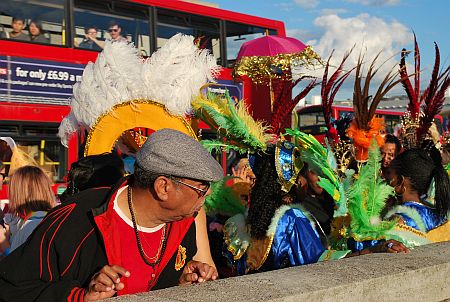

However, life for Londoners was not all “War” and “Work”! In the 17th and 18th centuries during the hard winter freezes, Frost Fairs were held on the River Thames, complete with ox-roasting, groups of musicians playing, stalls selling a variety of popular novelties and food, like mutton pies (the forerunner of our mince pies), fairground amusements and performing animals. The last fair to be held on the Thames was in February 1814. In 1831 the old London Bridge was replaced, and – with the removal of the “starlings” or piers upon which the old bridge rested – the river no longer slowed down sufficiently for it to freeze over sufficiently to support public events. Navigation was however vastly improved all year round, and the boat skippers were no longer prevented by ice from moving their boats up and down the river. Formerly they were forced to remain with their precious cargoes because they could not afford to leave them unattended to find other work during the freeze-up.
The River Thames also provided some of the greatest “shows” seen on water. In AD1422 the Lord Mayor’s Show took to the water. The participating barges of the City Livery companies became ever more ornate. Barges were covered in gold leaf and some rowed with oars of silver. In the 17 century the Lord Mayor’s procession included dramas and pageants. However, these came to an end in 1856 by which time the river had become overcrowded with steamships and was horribly polluted…..
It was an actor who established one of the most enduring of the traditions of the River Thames. In AD 1715 Thomas Doggett was so grateful to a local waterman for his efforts to ferry him home on a bad night, pulling against the tide, that he set up a rowing race for professional watermen. The winner receives prize money and also the coveted scarlet coat and badge, made of silver – hence the name of the race “Doggett’s Coat and Badge”. The race is still held on August 1st each year when professional watermen row from London Bridge to Chelsea.
The 18th Century – Boom and Competition
During the 18th century there was an enormous expansion in trade, and London became the World’s busiest port, dealing with commodities from all over the huge areas of the British Empire. The building of London’s Docks commenced to cope with the increase in trade.
Upriver the scene was the same – Reading received 95% of its goods by river. The construction of toll roads in the mid-18th century started to attract passenger traffic away from the River Thames. The Industrial Revolution led to rapid expansion of the canal system towards the end of the century and this linked the south of England and the Thames with the industrial North and Midlands. This gave rapid rise to growth of towns and settlements at the junction of the canals with the Thames, such as at Brentford and Limehouse. (see the section on the Thames and The Canal Connection).These new settlements needed supplies of food and perishable commodities and these too were carried up and down the Thames.
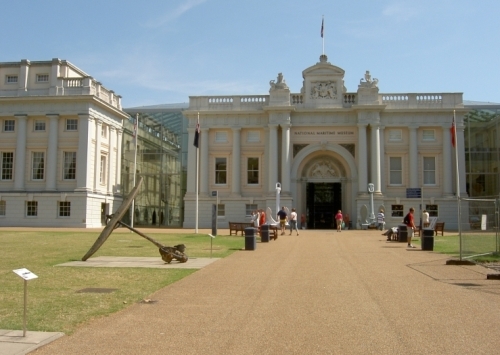
Photo here of the National Maritime Museum – photo courtesy Jeannette Briggs
The Royal Docks at Deptford saw the refurbishment of such ships as Captain Cook’s famous ships HMS Endeavour, Resolution and Discovery. They were originally Whitby coal ships and were specially fitted out ready for Captain Cook’s astounding voyages of discovery around the World and in the Pacific in the period 1759-1778. Following on from this, and other voyages by such famous sailors as Captain William Bligh and Captain George Vancouver trade increased at unprecedented rates, and the foundations of what became the British Empire (and later the Commonwealth) were laid.
The 19th Century - the Victorian Era and the Thames
The Port of London www.portoflondon.co.uk became the central trading post for a vast British Empire. More docks were built, in the face of intense competition from riverside wharves, who built huge warehouses down river from Tower Bridge. (Most of these warehouses now house riverside apartments and shopping malls.)

Tower Bridge and the Pool of London- photo by SW
River and canal trade expanded despite competition from the new railway network. However, it became apparent that those towns with railways expended rapidly, and those without did not. It was a time of transition and change, with steam powered cargo vessels appearing on the river alongside traditional Thames sailing barges and lighters. This was also an era of imaginative engineering. Evidence of the influence of the great Victorian engineers can be found all along the river. The embankments in London house the water supply to homes, plus the sewers, and protect London from flood.
The Great Stink
Some Victorian schemes had very far-reaching and serious environmental impacts – the widespread introduction of the flushing water closet, with sewers discharging straight into the Thames, turned the river into one vast open stinking sewer. The once thriving fishing industry died, as did thousands of Londoners, or cholera, as their main water supply was now polluted. Nothing was done however, until a particularly hot summer which made living near the Thames unbearable. Fumes from the river penetrated the recesses of the Houses of Parliament and made work there unbearable. MP’s decided at last that something had to be done….
In AD1864 Sir Joseph Bazalgette masterminded the laying of two enormous sewers along the Thames to collect and divert the sewage downstream to Beckton and Crossness. Here sewage farms were set up to deal with the effluent. At the same time the Metropolitan Line was installed and the Victoria Embankments were built on top, reducing the width of the Thames and improving the depth and speed of flow of the river.

Crossness Pumping Station Bexley - photo courtesy London Borough of Bexley
River of Death
The Thames runs through Southern England along a wide low lying valley – its flood plain. Throughout the centuries the Thames has burst its bank, swamping riverside settlements causing death and destruction. Because properties beside the river have always been popular people have often ignored the lessons of the past, and they continue to build on the highly desirable land of the Thames flood plain. High embankments and flood alleviation schemes are all part of man’s constant fight against Nature. The great threat to London comes from the sea.
Throughout history high tides and strong winds have pushed the sea up the estuary, flooding low-lying areas. It is recorded that AD 1816 people rowed through the Great Hall of the Palace of Westminster, whose floor was covered in dead and dying fish. As the flood waters receded the Victorians considered that the building of the Embankments would protect against flooding. However, as stated before, this resulted in the narrowing of the river, and increased its depth, thus making it necessary over the years to raise the walls still higher. The Thames is now 3 metres deeper than it was 300 years ago.

A Thames rescue boat
Henley Royal Regatta, held each summer

The river filled with small boats during the summer. Rowing in particular became a hugely popular pastime and clubs increased. Regattas became annual events. The world famous Henley Regatta dates from 1839, and still takes place every year at Henley in late June and early July. In AD 1829 the Colleges at Cambridge put out a challenge to those at Oxford, and a rowing race ensued between the two Universities – and so began the most famous rowing race in the World. The Oxford and Cambridge Boat Race is now the Nation’s favourite rowing race, and it takes place in late March or early April over a course between Putney and Mortlake, as it has done every year since 1845, with the exception of the War Years.boats for hire.During Victorian times there was an explosion of interest in the Thames as a leisure source, and many of the activities we enjoy on the river today started in this era. The new railways, which reached towns on the river such as Reading, Oxford and Windsor, provided a popular “day out” for those ordinary people who could afford it. Rowing boat firms sprung up with
River of Pleasure
Other river races grew up as a result of continuing interest in the Thames as a leisure location. Punting at Oxford was one of these, and so was sailing and canoeing. The first canoes to be used on the Thames were “dug-outs” in pre-historic times, made by our ancestors so that they could fish for food on the river. Early examples of dug-outs have been found in the riverbed, and one example is in the Museum of London. A long-distance canoe race from Devizes to Westminster Bridge also started during this period.

Photo - Stephen Worsfold
Cruising on the river for private pleasure also developed in the Victorian era. One can recall the iconic painting of pleasure boats at Boulters Lock near Maidenhead, full of well-dressed Victorian ladies and gentlemen in their straw boaters and striped blazers. Today cruises are available up and down the Thames, in chartered vessels and passenger boats, and also in self-drive boats for the more adventurous.
The 20th Century and Massive Changes
The 20th Century saw a huge decline in the use of the River Thames for trade, in the Port of London area especially. A combination of factors- including the introduction of container ships needing deepwater anchorage - led to the closure of the London docks. The Isle of Dogs and the Royal Docks were never to be the same. Because of the development of containerisation new docks were built at Tilbury to handle the lorries and containers coming in from all over the World and the emphasis on trade and the Thames shifted downriver from London itself.
Trade declined on the upper River Thames as well, mainly because goods were moved by road. Many older people remember trade on the river at Wandsworth and Lambeth right up to the 1960's. Coal for fire stations was moved in this way. Since this time there has been an unprecedented surge of building programmes, which have changed the character of the London riverside areas from industrial use to residential use. To own an apartment by the riverside with river views is now a treasured (and expensive) aspiration.

Photo : riverside walk – photo courtesy of Stephen Worsfold

New property in Newham by the River - photo David Auckland


The Museum in Docklands - photo courtesy Museum of Docklands
Further alternative use of the Docklands area has been made with the construction of the London City Airport, which is now linked by the Docklands Light Railway to the City of London. Leisure activities have also grown in the docks themselves. ExCeL exhibition centre situated on one of the docks hosts the International Boat Show every January, and watersports clubs and societies meet to encourage use of the docks for sailing, canoeing and so on. Hotels have also sprung up in this area, which cater for business meetings, weddings and weekend breaks.
New use has also been made of the River Thames by the introduction of a regular commuter service by boat between piers in Docklands and the centre of London. When the bombing attacks hit London in 2005 the Thames boat commuter service kept running. Tourism played a great part in the use of the river for boat trips up and down the Thames in London, and a river trip, accompanied by a running commentary from one of the experienced boat pilots on the history in front of you is a “must-do” for most tourists visiting London. The Tate to Tate boat service by fast catamaran also was introduced to transport people between the Tate Galley on Millbank and the Tate Modern gallery at Bankside. The Tate Modern is itself a success story – formerly the huge Bankside Power Station belching out noxious fumes for more than 100 years, it was completely refurbished in AD2000 and reopened as a showcase for the latest in Modern Art. Connected to the north bank of the Thames at St Pauls, by the Millennium Footbridge, it is yet another example of the River Thames (and its buildings) re-inventing itself.
River of Life Back From the Dead
During the first half of the 20th Century the quality of water in the River Thames declined. A report in the 1950ies stated that there was no fish life between Kew and Gravesend. A determined effort was made from 1960 onwards to clean up the Thames in London, with the result that it is now one of the cleanest rivers in the World.

The Thames in Autumn at Marlow - photo Jeannette Briggs
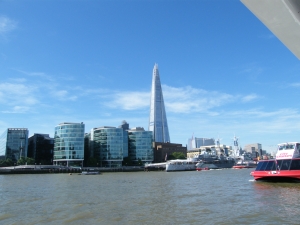
The Shard from the River- photo Jeannette Briggs
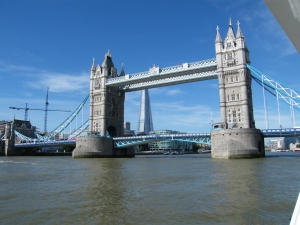
Tower Bridge from the River - photo Jeannette Briggs
The 21st Century and The Future
Development is still ongoing in the Thames valley. Huge blocks of luxury apartments are springing up all along the riverside down what is now termed the “Thames Gateway between the Thames Barrier and Tilbury, and especially on both banks of the river between Chiswick and Docklands in London.
Where once stood an old powerhouse or factory, warehouse, or gas-holder, there are now trendy luxury apartments which command astronomical prices, particularly if they come complete with a “river view”. This is especially true of London. Battersea Power Station was decommissioned in 1983. Following restoration, it opened to the public on 14 October 2022 with shops, restaurants and leisure venues, within a wider neighbourhood that also includes homes and workplaces.

Battersea Power Station
At Woolwich’s Royal Arsenal, the Firepower museum opened in 2001 and closed in 2016. Its Royal Artillery collections moved to storage in Wiltshire while plans were developed for a new museum near Larkhill.
On what has become known as the Millennium Site at Greenwich, where the river makes a huge meander beyond the Royal Naval College at Greenwich the Millennium Dome (now known as the O2 Dome) was constructed on the site of an old British Gas power station. The Millennium Exhibition was not a huge success, but the Dome still stands, and had become a bit of an icon. It was used for some of the sports during the Olympic Games.
Further downriver, at Gallions Reach the wastelands of Beckton have been cleansed of their industrial residue, like cadmium deposits and asbestos, and now proudly offer shops, offices and housing, moorings in a new marina and a new student village for the University of East London. The Thames Gateway Bridge was proposed here to link Beckton and Thamesmead. The Mayor dropped that scheme in 2008. In July 2025 the government lifted the planning protection that had reserved land for the crossing. The Silvertown Tunnel, a separate crossing linking Silvertown with the Greenwich Peninsula, opened on 7 April 2025.

Bluewater Shopping Centre Dartford - photo courtesy Dartford Borough Council
The high-speed rail link between Paris and the rest of Europe and St Pancras in London also crosses the River Thames at this point. It passes the Olympic Site at Stratford. The centres of population on either side of the Thames such as Bexley, Gravesend, Dartford, Tilbury and Newham also continue to develop, with amenities and road and rail connections, plus new shopping venues such as Lakeside at Tilbury and Bluewater in Dartford.

Dartford Bridge and the Thames - photo courtesy Dartford Borough Council
"Old Father Thames Keeps Rolling Along...........Down to the Mighty Sea!"
We can look even further into the future. The north bank of the Thames as far as Stratford saw the building of the Olympic site in AD 2012 – and it is possible that more change will come to this area in the next six years than in the whole of the past 2000 years.
Further example - if any were needed - that the River Thames “keeps rolling along” (to quote from the old song) "footloose and fancy free, down to the mighty sea" - a River of History from the Past to the Future.
Just a few facts about the River Thames:
1) The Thames contains over 80 islands ranging from the large estuarial marshlands of the Isle of Grain and Canvey Island to small tree covered islets like Rose Isle in Oxfordshire
2) In the Great Stink of 1858 the pollution in the River Thames became so bad that sittings in the House of Commons had to be abandoned.
3) On average one body a week is retrieved from The River Thames.
4) Thames - the movie star. A boat chase on the Thames forms the opening scene in the James Bond film The World Is Not Enough.
5) The River Thames runs through 9 counties: Wiltshire, Oxford, Gloucestershire,Berkshire, Buckingham, Surrey, Essex , Kent and Greater London.
6) There is only 1 remaining working mill on the Thames - Mapledurham Mill.
7) There are 44 locks on the River Thames to allow navigation.
8) The River Thames is home to 119 fish species.
9) London's Tower Bridge was first opened for River Traffic in 1894.
© 1999 - 2026 The River Thames Guide Ltd.